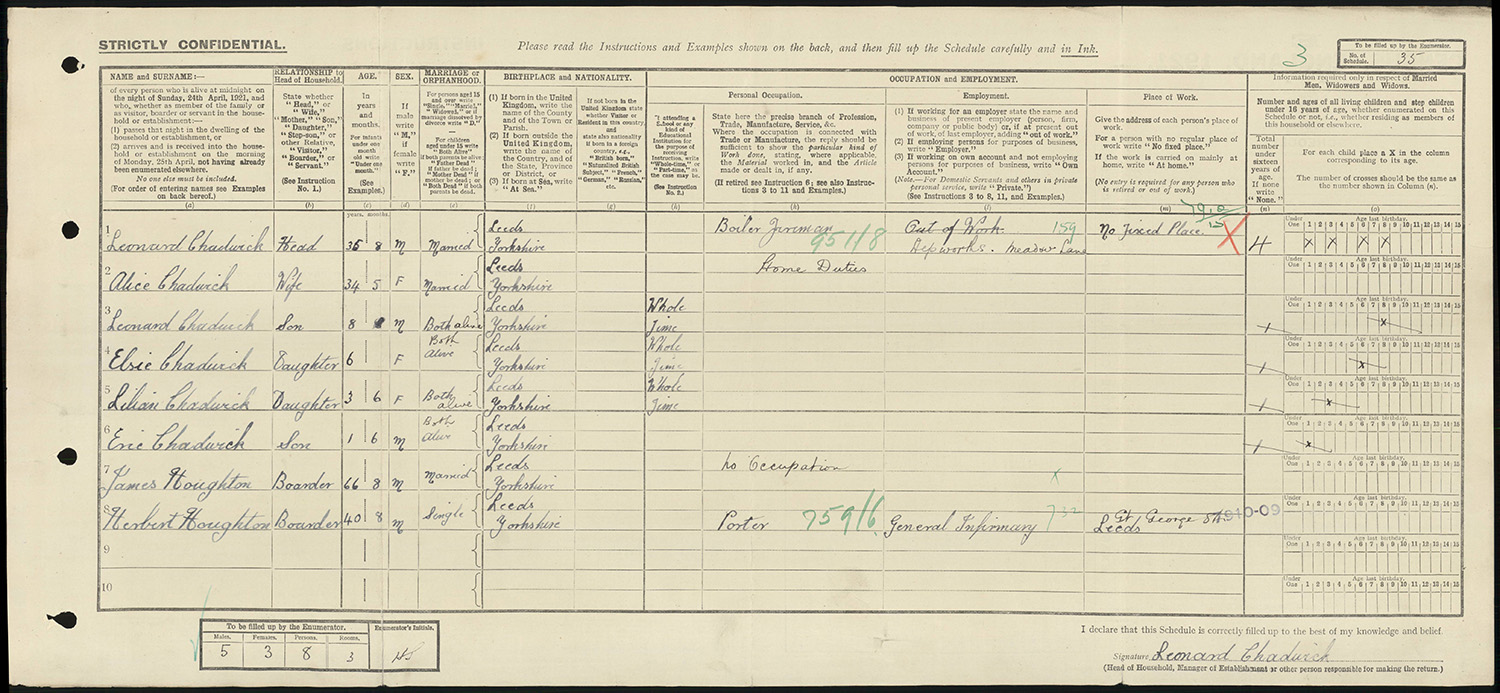
James Houghton II

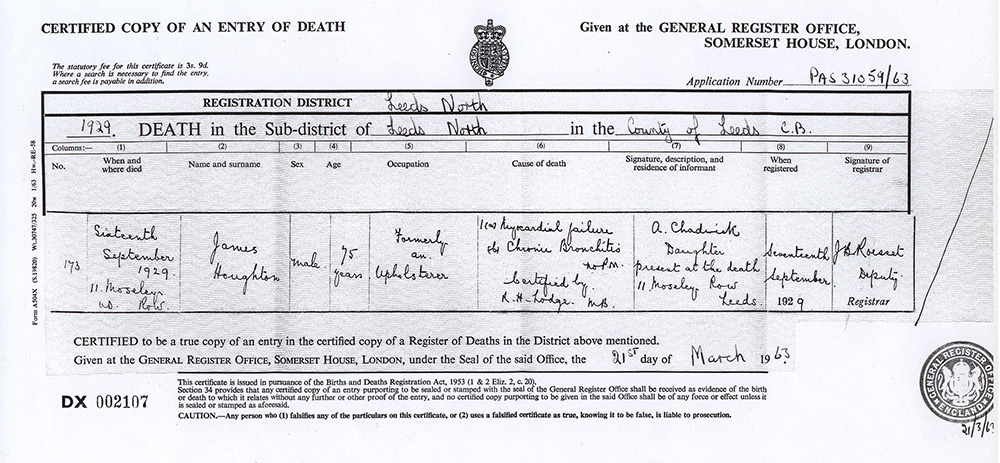
02.11.1853 - 16.09.1929. A@TOD 75.

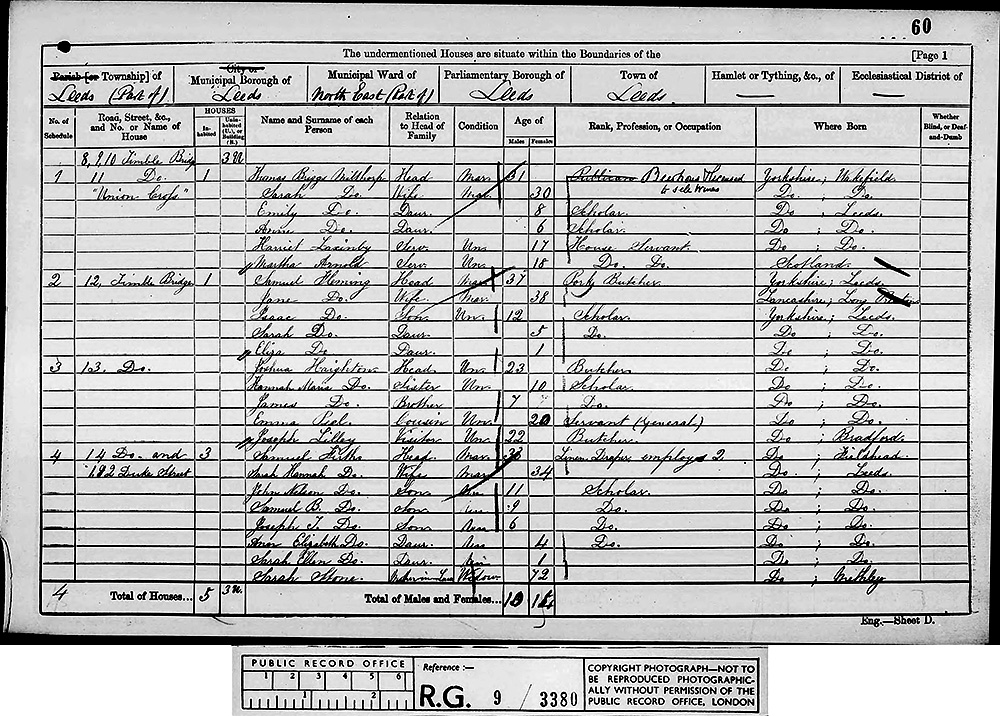
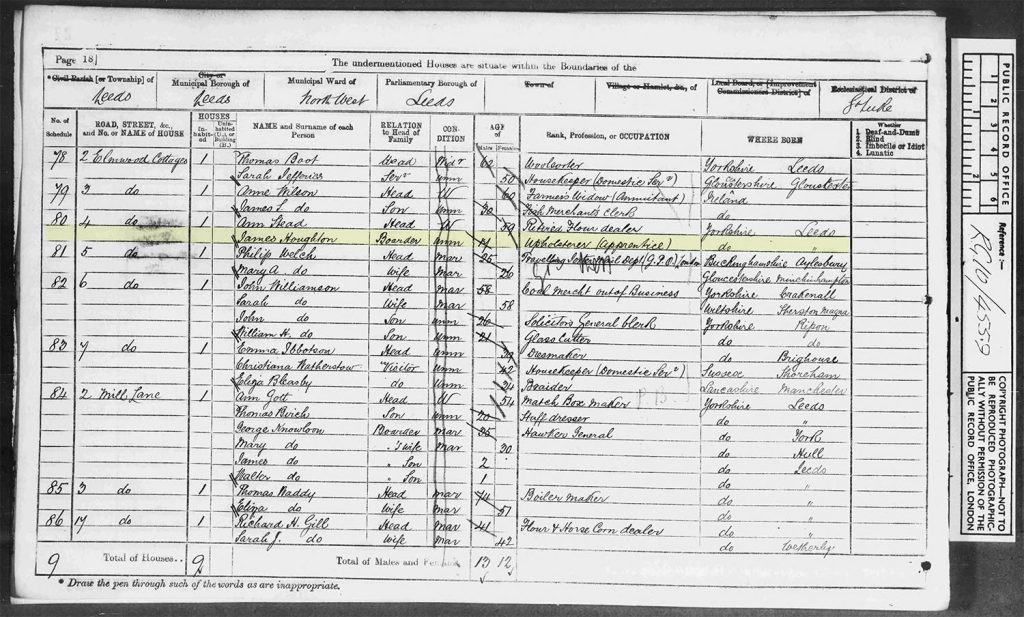
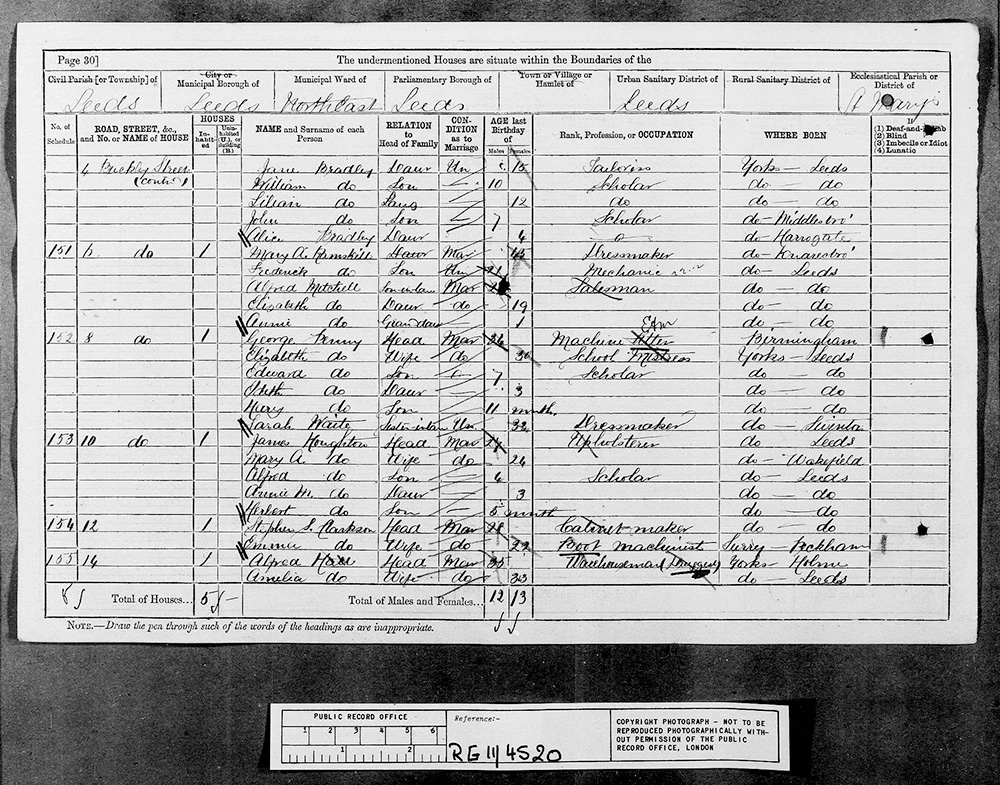
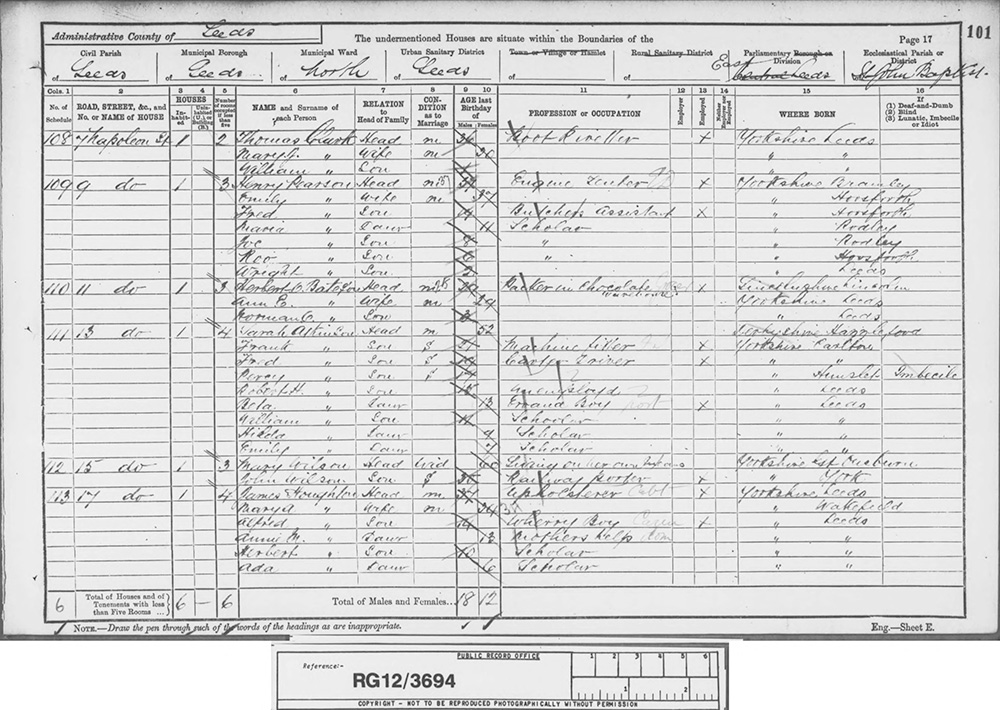
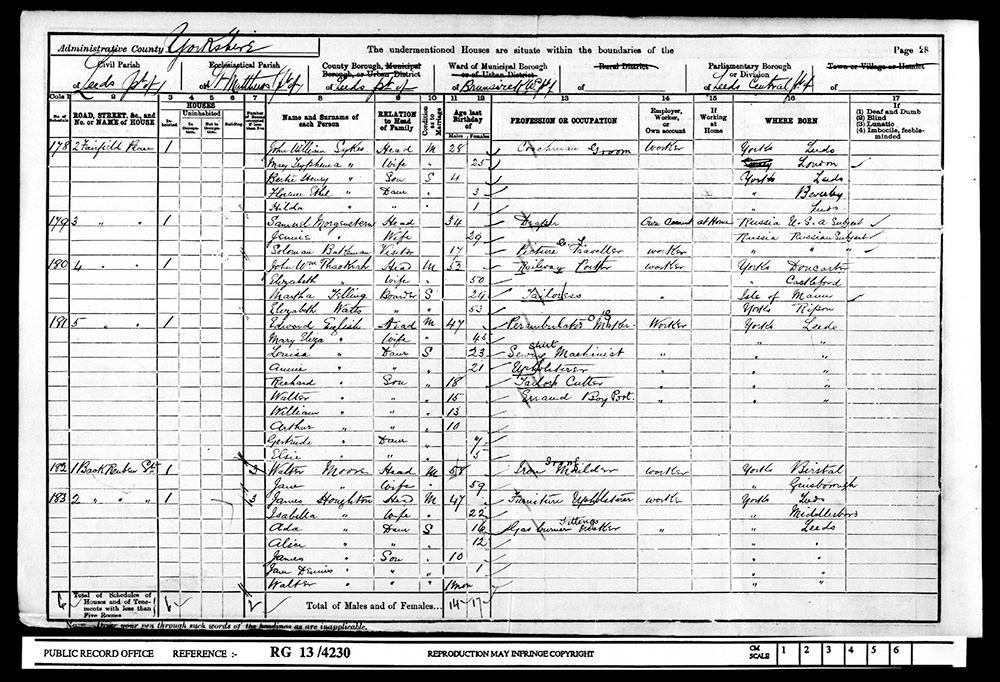
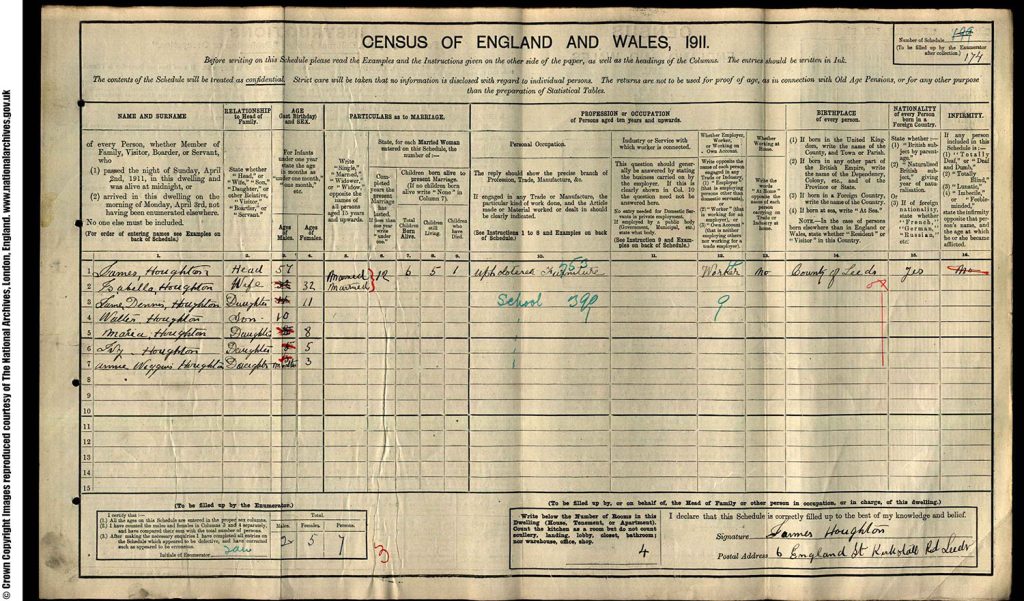
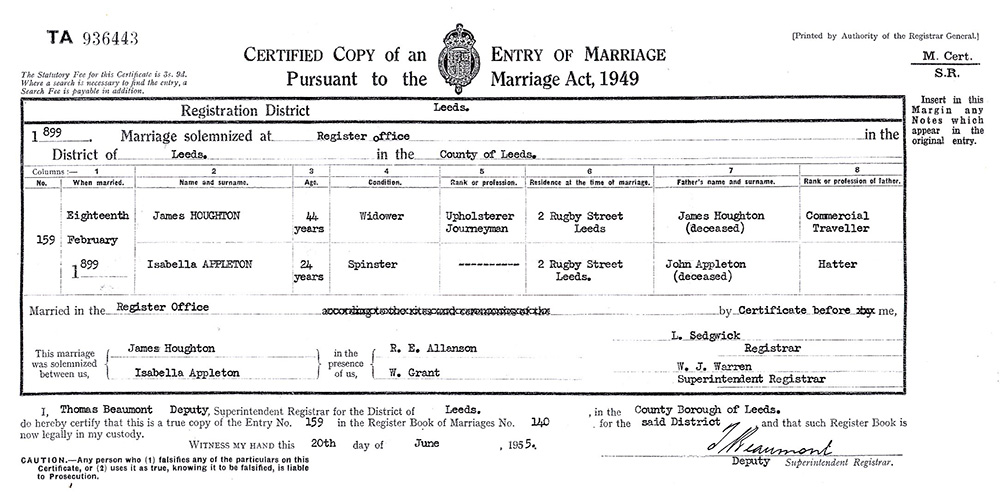
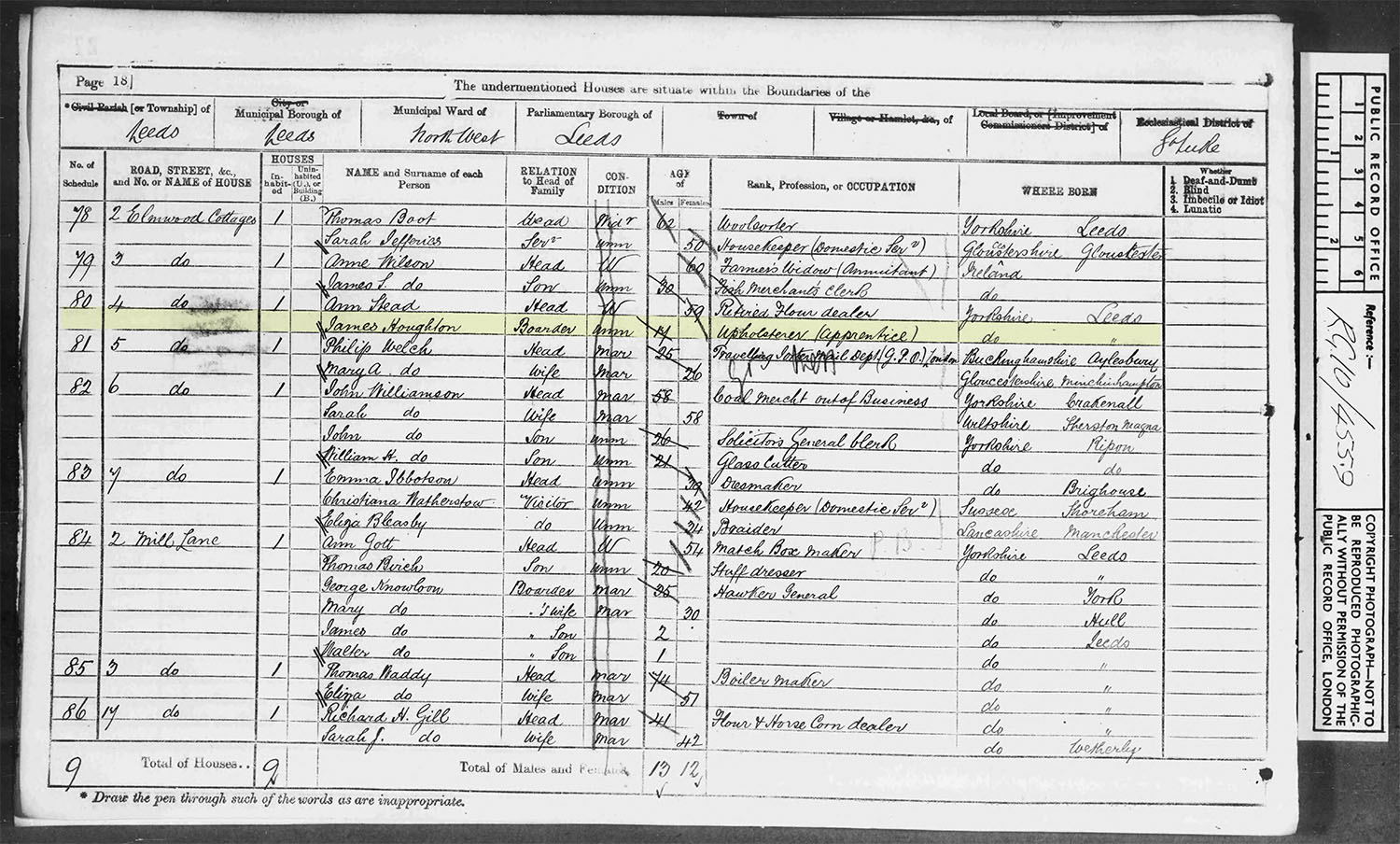
James was an upholsterer, whether he worked for his brothers is unknown. There is some suggestion within the family that he had poor sight but whether from birth or later on is unknown but the fact he signed later birth registrations with a cross may be significant. He was certainly literate because he acted as secretary for the local upholsterers’ society at one time. Such societies were proto trade unions which used accrued subscriptions to pay benefits to members in times of need and also acted as a point where upholsterer’s coming into the town could make contact with others in the trade and learn of vacancies.  This was only open to men who had been properly apprenticed – another aim of such societies was to keep unapprenticed men out of the trade.  The ‘house of call’ was usually a public house, in the upholsterers’ case the Windsor Castle, Castle Hill.

In Kelly’s Leeds, Sheffield, Rotheram Diectory 1893 there is a Houghton J, secretary to the Upholsterer’s Society 20 Ney St. listed.  In the official section it gives the place of meeting of the society as the Windsor Castle Castle Hill and the secretary again as J Houghton, 20 Ney Street, Green Lane.

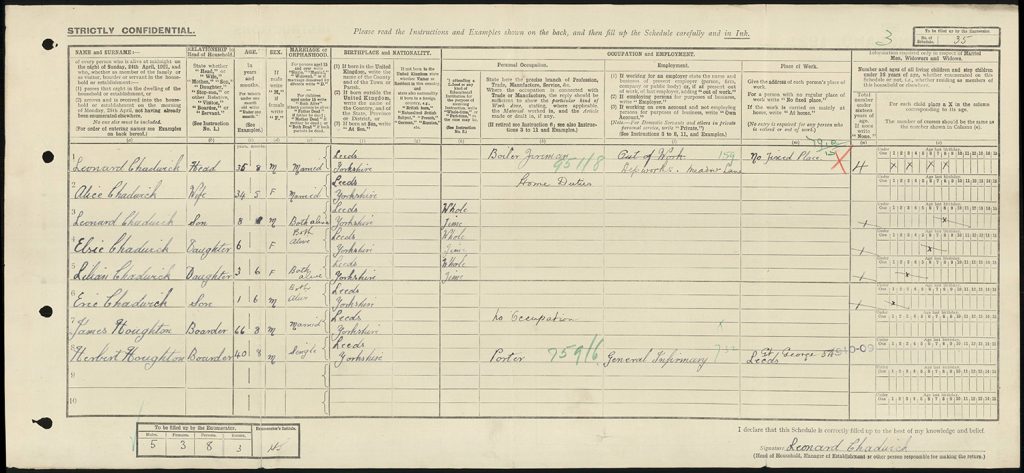
James was living with his third daughter of his first marriage – Alice Chadwick – when he died and had been there since at least 1925 his second marriage -which may have been one of convenience – having broken down.

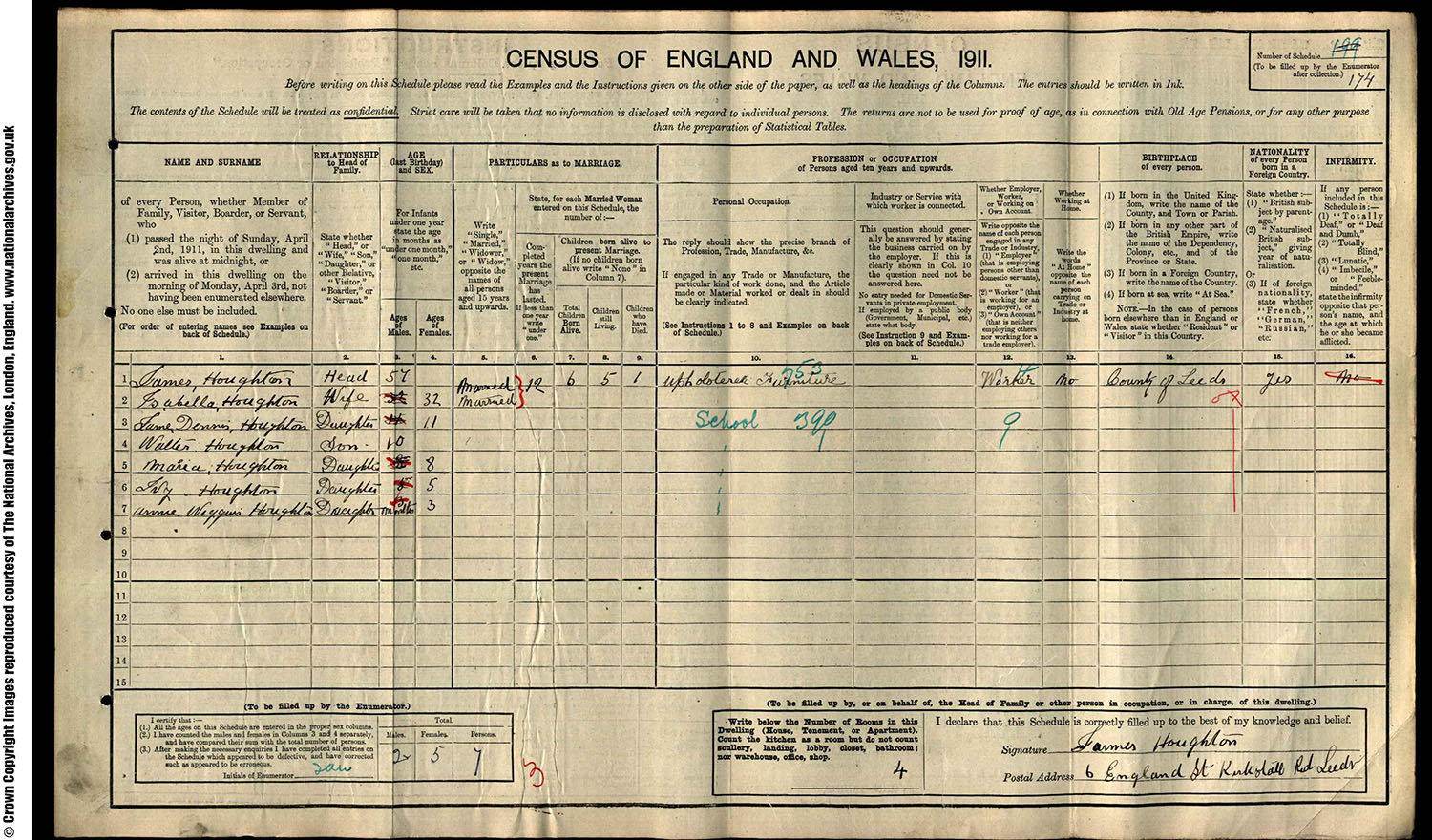
Isabella, his second wife, had had a son, Jack Cale, in April 1921 fathered by John Cale the man she married nine days after burying James.  He was 68 and she 51.  Was it his son?  How many of her other eight children were James’?

Born  2nd November 1853 [Birth Certificate]

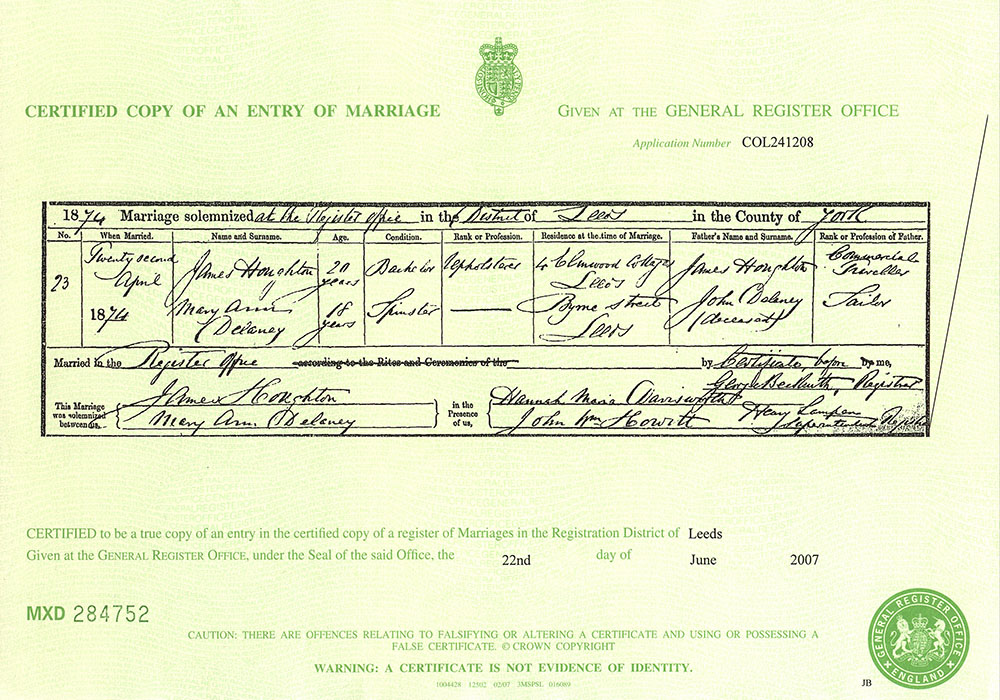
Married to Mary Ann Delaney 16th September 1929 [Marriage Certificate]

Died 22nd April 1929 [Death Certificate]

Conversations with Marie Wilkinson.

March 2004.

Marie was born in Napoleon Street in 1930 and lived there as a child.  She moved back with her husband and two children to occupy her grandmother’s house on the latter’s death.

She made the point that there was a wide range of houses in the street. Different builders had each built a few houses and each had a different style. I had assumed that they would build both sides of a back to back but after reading Beresford think that this need not necessarily be the case and that houses could be left as ‘hanging backs’ until someone built on the other side. Some houses had two bedrooms (Marie’s mother’s) some one (Marie’s), some a scullery, some an attic, some had lots of steps up etc. Rents differed accordingly by a few shillings or pence and people would move for more or fewer facilities according to their changing financial circumstances. There were many landlords each having a few houses and they would call each week for the rent (see Arthur Morrison’s story All that Messuage). Knowledge of vacant houses usually passed by word of mouth but in Morrison’s story there is a notice put in the window which was presumably another device. Marie said that you went to see the landlord and could be in within a day. There was no need for a removal van. The few possessions could be put on a hand cart (see Hoggart  A Local Habitation ) and would consist of the beds and ‘meagre’ (her word)  furniture (table? chairs?)  Reading Morrison would suggest that there may not be much communication between landlords so that ‘shooting the moon’ would be easier than might be supposed.  Then as now there would be a desire to keep places tenanted. John Denton Houghton’s will mentions rents so that he may have been one such landlord.

Marie’s house had one room up and one down. There was no attic but she did have a cellar. The stairs ran up the back wall and were unboxed when they moved in.  The cellar was used for coal but she also did her washing down there. The set pot which in other parts of the country is known as a copper and is a pot with heat beneath it which was used for heating water, especially for washing, was down there. There was not a tap in the cellar so that water had to be carried down and waste water brought up again. It did ‘make things rather damp’ she said but with a hint that things may have been rather damp anyway. She had a mangle down there as well. The gas meter was in the cellar. There was a sink in the living room [the house?] by the side of the fire where the washing up was done. Here was the only water supply (cold tap) so presumably shaving etc had to be done there as well. (Jack Houghton mentioned that in an aunt’s back to back that he stayed in the sink beside the fire was in a cupboard and there was no cellar) This room was very cramped she said ‘with your table and everything.’ At the top of the cellar steps there was a stone slab called the ‘cellar head’ and milk, butter etc was put on this to keep cool. The milk was brought by the milkman and ladled into one’s own jug. (presumably this was when she was a child) She said the brass ladles and jugs were lovely. Food shopping was done every day as there were lots of shops nearby on Green Road. She said there was a lovely Ladies’ outfitters that took up a double shop. She said that the net curtains were washed regularly and people took pride in the appearance of their nets which did, ‘make the houses look nice.’ The steps and windowsills were regularly washed and ‘stoned’. Her mother had blinds with big ‘butterflies’ but she had curtains. There were flagstones outside.

When she was young she said that children had new clothes at Whitsun and relatives and neighbours would give them pennies and they went on ‘walks’ through the streets organised by various churches dressed up in them.  This was especially prevalent amongst Roman catholics who also organised little trips into the country where they had picnics.

There was a block of lavatories between every two to four houses and you shared with one other house, taking it in turns to clean. Bathing had to be done using a tin bath but once a week on a Friday night they went to the Slipper Baths. Washing was hung across the street. It had to be hoisted high as the coalman used to come down the street on his cart! Getting and keeping washing clean was a constant struggle in the very smoky atmosphere of Leeds as Edith Houghton said.
Marie’s mother had two bedrooms and the stairs ran straight up from the front door.  She cooked on a range (Marie said a fire with an oven so it sounds pretty basic) and then progressed to two gas rings.  The house was gas lit.  She scrubbed the steps and the flags and donkey stoned the edges. Marie said the houses were freezing in winter and overpowering in the summer. It is worth bearing in mind as well her comment that they were, ‘rather damp,’ as well as Frank .. remarks on the damp patch on the wallpaper. This could be penetrating damp as he suggests, because of decayed pointing but it may also have been due to porous bricks and/or perhaps rising damp.

When she moved back into the road Marie had her mother a few doors up as her mother had before her, and aunts round the corner.  As she said, ‘there was always help about.’  She stressed how much neighbours helped each other, (watched children, fetched shopping etc). There was a feeling that they were all in the same boat.  They were all as poor as each other and it was a case of helping each other to get through. I don’t think there was any sentimentality about this. People still fought and fell out and disliked each other but there was perhaps a class consciousness that led to a support even for those you didn’t get on with. Life was much more public and much of it led on the street etc. rather than in the house. Misfortune was shared but so was good fortune with little parties etc [nan’s life] I remember people helping each other with errands etc.

Medicines were made up by the chemist as doctors had to be paid for.  Apparently you could almost specify the mix for a cough mixture etc.

Marie said that the houses in Napoleon Street were due to be cleared in 1938, the year the Quarry Hill flats were finished but the war intervened and they were finally cleared in 1956. She says her two children couldn’t understand that their new three-bedroomed semi-detached was all their and that they could go in the hall etc.

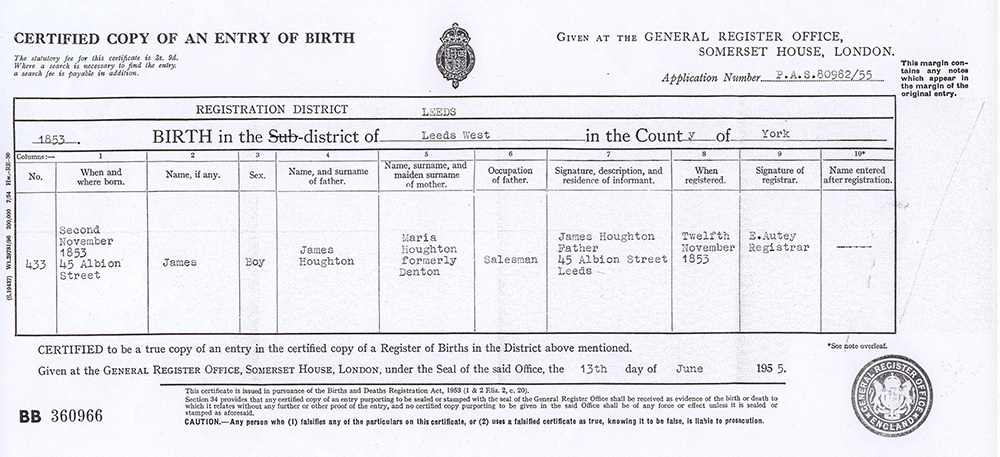
James Houghton II Doc's